How Does The Employer Credit For Family and Medical Leave Work for Suffolk County Small Businesses?

How Does The Employer Credit For Family and Medical Leave Work for Suffolk County Small Businesses?

Quick Answer: The employer credit for family and medical leave provides small businesses a federal tax credit worth 12.5% to 25% of qualified leave costs. In 2026, you can claim this credit on actual wages paid during FMLA leave or on commercial insurance premiums. Qualification requires a written policy offering at least 50% pay to employees earning $96,000 or less.

Key Takeaways

  • The Section 45S Paid Family and Medical Leave tax credit is now a permanent federal incentive for small businesses under the One Big Beautiful Bill Act (OBBBA).
     
  • Eligible employers can secure a federal tax credit ranging from 12.5% to 25% to directly offset the costs of providing qualified leave to their team.
     
  • Starting in 2026, businesses can claim this credit against commercial insurance premiums (like group short-term disability policies) even if no employees actually take leave during the year.
     
  • To qualify for the credit, an employee must work at least 20 hours per week and have earned a prior-year compensation of $96,000 or less.
     
  • To lock in these savings, your Suffolk County business must establish a formal, written employee policy that explicitly guarantees a minimum of two weeks of FMLA-qualifying leave at 50% wage replacement or higher.


When life happens to your employees (whether it’s the birth of a child, a medical emergency, or a sudden family crisis), you have to figure out the logistical reality for your Long Island business:

How will your cash flow sustain paying a regular salary to an employee who isn’t actively working?

That’s where the Section 45S tax credit can help: an incentive that provides a dollar-for-dollar tax credit to offset up to 25% of those leave costs.

And thanks to recent permanent updates under the OBBBA, the credit now offers more value for small businesses than ever.

If you want to protect your bottom line while still taking amazing care of your team, it’s time to consider how this credit fits into your tax strategy.


What is the Section 45S tax credit?

The Section 45S tax credit, or the employer credit for family and medical leave, is a federal tax incentive designed to help small business owners offset the costs of providing paid family and medical leave to their team. The credit amount is based on a percentage of the wages you continue to pay employees while they’re out on qualified leave. It was recently made permanent by the OBBBA.

The point of this credit is to support your bottom line when your employees need time off for major life events. Like the birth or adoption of a child, caring for an immediate family member with a severe illness, dealing with their own serious health crisis, or managing military-related family emergencies.


How much is the employer credit for family and medical leave worth?

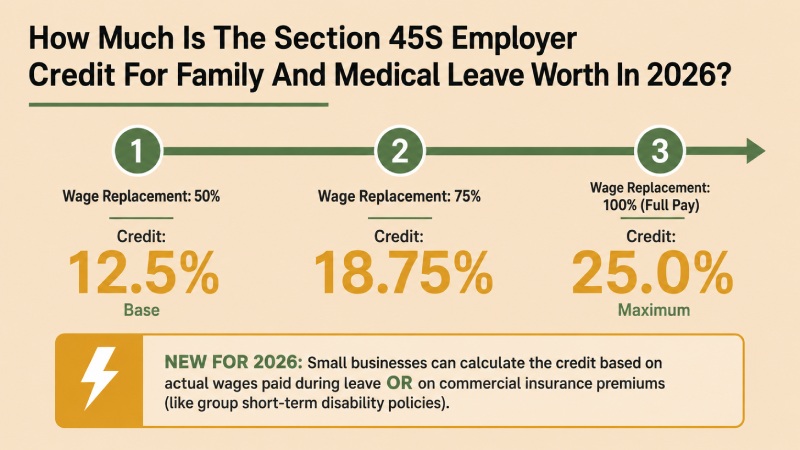
The credit ranges from 12.5% to 25% of the wages you pay during your employee’s leave, for up to 12 weeks per employee per tax year.

The exact percentage depends on how much of their normal salary you cover. If you pay 50% of the employee’s regular wages while they are on leave, you qualify for the base credit of 12.5%.

For every percentage point of pay you provide above the 50% threshold, the tax credit increases. If you choose to pay 100% of their regular wages during their leave, your credit hits the maximum of 25%.

Also, thanks to the OBBBA, you can now calculate the credit based on the commercial insurance premiums you pay to fund a qualifying leave policy (such as a short-term disability policy).
 

Who qualifies as an eligible employee?

To qualify, an employee must have been on your payroll for at least one year. Also, their compensation from the prior year can’t exceed a strict federal income threshold. For the 2026 tax year, the cap restricts the credit to employees who earned $96,000 or less in 2025.


How to write a paid leave policy 

To be eligible for this credit, your Suffolk County business has to have a formal, written paid leave policy already in place that explicitly guarantees the following protections:

  1. The policy must offer at least two weeks of paid family and medical leave annually for full-time employees (and a prorated amount for part-time workers).
     
  2. The policy must guarantee at least 50% of the employee’s standard wages.
     
  3. The document must contain strict non-interference and anti-discrimination clauses, so employees won’t be penalized, demoted, or discouraged from using their leave.

Also, the paid leave must be specifically earmarked for Family and Medical Leave Act (FMLA) purposes.

For example: Sarah owns a boutique marketing agency and gives her team 4 weeks of “no-questions-asked” PTO to use for vacation, sick days, or personal time. One of her copywriters uses 3 weeks of this PTO bucket to undergo and recover from a major medical procedure.

Even though the employee used the time off for a genuine, FMLA-qualifying medical emergency, Sarah cannot claim the employer credit for family and medical leave on those wages. Because standard PTO or vacation buckets don’t count. 

Under the OBBBA, your written policy only needs to cover employees who customarily work more than 20 hours per week, removing the logistical headache of tracking irregular part-time staff.

And while the standard rule requires an employee to be on your payroll for a full year, you can now elect to reduce this requirement to just six months.


The “no double-dipping” rule

If you choose to claim the Section 45S credit, you have to reduce your business’s standard deduction for employee wages by the exact amount of the credit you receive. And, the specific wages used to calculate your Section 45S credit can’t be used to qualify for any other federal general business tax credits.

Which means maintaining meticulous payroll records, tracking precise leave dates, and preserving your written policy documents are vital to surviving an IRS audit and maximizing your return.

If your state already mandates paid family and medical leave, the OBBBA clears up the double-dipping ambiguity: State-mandated benefits can count toward meeting the required baseline (e.g., offering 2 weeks of leave at 50% pay).

But state-mandated payments cannot be used to calculate the federal credit. You can only claim the credit on voluntary compensation paid above and beyond what the state forces you to pay.


Should you claim the employer credit for family and medical leave?

If you’re wondering if this credit could help lower your business’s tax liability, there are a few items we need to consider first:

1. Your employee compensation and hours distribution. We need to check your payroll data to see who actually qualifies. First, we need to calculate how many of your employees earned $96,000 or less in the prior year. (The bigger your middle-class or hourly workforce, the more potential savings to be had.)

Then, we’ll analyze how many part-time employees work more than 20 hours per week, because your written policy must uniformly cover them.

2. Your funding model. Do you want to pay wages out of pocket when someone goes on leave, or do you prefer a predictable monthly insurance expense? Because the tax code allows you to claim the credit against commercial insurance premiums (like group short-term disability), I can run a comparative analysis to see which model saves you more cash while minimizing risk.

3. Your geographic footprint. Where are your employees physically located? If you have team members in states with state-mandated paid family leave laws, we need to look at what the state forces you to provide and calculate the tax benefit of voluntarily adding an extra layer of employer-funded pay to trigger the federal credit.

4. Your entity structure and current tax liability. For pass-through entities (S-Corps, LLCs, Partnerships), the credit flows to your personal tax return. So, we’ll have to look at your personal tax bracket and overall liability to make sure you can actually use the credit this year.

Also, if your business is projecting a net loss, you won’t owe federal income tax. We can plan a carry-forward strategy, banking the credit to offset up to 20 years of future tax bills.


How can I claim the employer credit for family and medical leave?

If you want to bake Section 45S into your tax planning this year, focus on taking these proactive steps right now:

Step 1: Pull your prior-year payroll reports 

Ask your payroll provider for a report showing every employee’s total compensation and average weekly hours. Isolate the employees who earned $96,000 or less. This gives me the exact data I need to calculate your maximum potential tax credit.

Step 2: Request an insurance assessment 

Contact your commercial insurance broker and ask for quotes on a group short-term disability policy or a private paid family leave policy that covers FMLA-qualifying events. I’ll analyze these quotes to find the tax-credit yield on those monthly premiums.

Step 3: Update your employee handbook 

Work with an HR professional or employment attorney to draft the formal, written policy language required by the IRS, complete with the mandatory “non-interference” and “anti-retaliation” clauses. The policy must be active and communicated to your team before you can claim a single dollar of the credit.


Final thoughts 

If you’re feeling a bit of administrative hesitation with these rules, don’t let that stop you from saving valuable tax dollars. I’m here to help you through the process. 

Just get your appointment on my calendar, and we’ll audit your payroll, structure your written policy, and maximize the tax savings your small business is entitled to.

631-485-7272


FAQs

“Do I qualify for the Section 45S credit if my business has fewer than 50 employees?”

There is no minimum company size requirement to claim the Section 45S credit. While the traditional federal Family and Medical Leave Act (FMLA) mandate only applies to businesses with 50 or more workers, any small business can voluntarily choose to offer a qualifying policy and claim this tax credit, even if you only have two or three employees.

“Can I still get the Section 45S tax credit if nobody takes time off this year?”

Thanks to the 2026 OBBBA updates, if you use the premium method, you can claim a tax credit on the commercial insurance premiums you pay (like group short-term disability) throughout the year. The credit is tied to the money you spent on the policy premiums, meaning you still get your tax break even if your team stays perfectly healthy and nobody takes a single day of leave all year.

“Can I use my standard, multi-purpose PTO or vacation bucket to claim this credit?”

The IRS explicitly states that generic PTO, standard sick leave, or regular vacation days do not count toward the Section 45S credit. To qualify for the tax incentive, your written policy must state that the paid leave is exclusively designated for FMLA-qualifying events (such as the birth of a child, serious illness, or military caregiving) and cannot be used for generic personal time off.

“Can I claim the Section 45S tax credit for my own family leave if I am the business owner?”

The Section 45S credit is strictly designed for qualifying employees on your payroll. Because of strict IRS rules regarding business ownership, self-employment structures, and the fact that a qualifying employee’s prior-year compensation cannot exceed the middle-class income cap ($96,000 for the 2026 tax year), small business owners themselves almost never qualify for the credit on their own leave.

“How much tax credit do I get if my insurance policy covers 60% of an employee’s normal wages?”

You will receive a 15% tax credit. The Section 45S credit operates on a sliding scale. The baseline credit is 12.5% if you cover the minimum 50% of an employee’s wages. For every single percentage point of wage replacement you provide above that 50% baseline, your tax credit increases by 0.25%. Since a 60% wage replacement policy is 10 percentage points over the baseline, you add an extra 2.5% to your credit rate, bringing your total tax credit to 15% of your paid premiums or wages.

“If my state already mandates paid family leave, can I still claim the federal Section 45S credit?”

Only on voluntary amounts you pay above the state mandate. Under the 2026 rules, you can use your state-mandated program to prove your Long Island business meets the minimum eligibility requirements to participate. However, you cannot claim the federal tax credit on the baseline dollars the state forces you to pay. You can only claim the Section 45S credit if you voluntarily top up your policy to provide a higher percentage of wage replacement than the state baseline requires.

“Do I lose the credit if my business has a net loss this year?” 

No, you do not lose it. Because Section 45S is a non-refundable general business credit, it cannot reduce your federal tax liability below zero to give you a cash refund in a loss year. However, the IRS allows you to bank the unused credit and carry it forward for up to 20 years to offset your future profitable years, or carry it back 1 year to get a refund on taxes you previously paid.

How To Hire An Intern For The Summer For Your Suffolk County Business

How To Hire An Intern For The Summer For Your Suffolk County Business

Key Takeaways

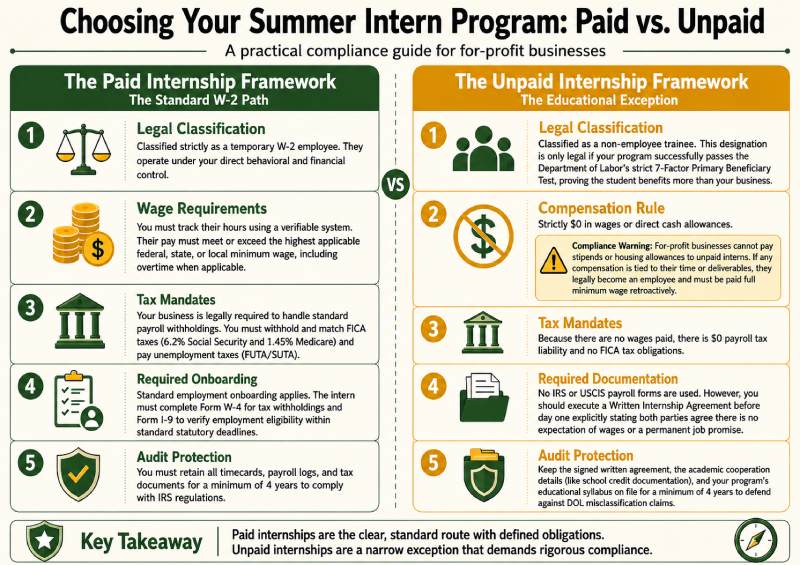
  • Paid summer interns must be classified as W-2 temporary employees rather than 1099 independent contractors because they operate under your direct supervision.
     
  • To legally hire an unpaid intern, your program must pass the strict DOL “Primary Beneficiary Test” proving the student benefits more than your business.
     
  • The Student FICA Exemption does not apply to small businesses, meaning you are required to withhold and match standard Social Security and Medicare taxes.
     
  • The IRS treats nearly all intern compensation, including lump-sum stipends and housing allowances, as taxable income that must be processed through payroll.
     
  • You must use a verifiable timecard system and securely retain all intern tax forms and payroll records for at least four years to protect against audits.


Hiring summer interns could be a win-win for your Suffolk County business. You get extra hands to tackle your mounting to-do list, and a motivated student gets real-world experience.

But before you post that job opening, we need to go over the legal reality. A simple mistake in how you classify or pay your summer help can easily trigger an expensive audit or steep penalties. 

Here’s the tax-compliant guide on how to hire an intern for the summer.


What are the different types of internships?

From a tax and payroll perspective, how you classify your summer intern dictates your entire legal and financial responsibility. Mistaking a paid employee for an unpaid volunteer can result in severe Department of Labor (DOL) penalties and back-tax liabilities.

Here’s a breakdown of the different types of internships and how they impact your small business tax obligations.

Paid internships

If you’re compensating an intern for their time, deliverables, or hours worked, they are generally treated as temporary employees.

And because paid interns are employees, you must handle all standard payroll and tax requirements:

  • You must have the intern complete a W-4 for tax withholdings and an I-9 to verify employment eligibility on or before their first day.
     
  • You are responsible for withholding Social Security (6.2%) and Medicare (1.45%) taxes from their wages, as well as matching those amounts as the employer.
     
  • You must pay federal and state unemployment taxes on their earnings, just as you would for a regular employee.
     
  • In most states, temporary workers and interns must be covered under your business’s workers’ compensation insurance policy.

Unpaid internships

To determine if your intern can legally go unpaid, the Department of Labor (DOL) uses the Primary Beneficiary Test.

This test evaluates who derives the most value from the relationship. For an internship to be legally unpaid, the intern must be the primary beneficiary, not your business.

To classify an intern as unpaid, your program has to satisfy these core factors:

  • The training provided must be similar to what the intern would receive in an educational or classroom environment.
     
  • The internship must primarily benefit the intern’s learning and career development, rather than the immediate operational needs of your company.
     
  • Unpaid interns cannot displace regular, paid employees. Their tasks should complement your existing workforce while giving educational benefits to the intern. 
     
  • The length of the internship is strictly limited to the period during which it provides meaningful, active learning for the student.
     
  • There must be a clear, written understanding that there is no promise or guarantee of a permanent job at the conclusion of the internship.
     
  • Both parties must explicitly agree from the very beginning that the intern is not entitled to wages or financial compensation.


What happens if I misclassify an intern? 

If the IRS or the Department of Labor audits your business and finds that an unpaid intern was performing the duties of a regular employee, they will reclassify the intern as an employee.

If this happens…

  1. You’ll be required to pay the intern back wages matching at least the federal or state minimum wage, plus overtime.
     
  2. You’ll owe unpaid FICA and FUTA taxes, plus steep interest and failure-to-deposit penalties to the IRS.
     
  3. Violating the Fair Labor Standards Act (FLSA) can expose your small business to lawsuits.


How do I handle payroll for my summer interns?

There are three critical payroll considerations you need to think about when you hire an intern.

1. Employee classification

It’s tempting to classify your interns as 1099 independent contractors because it saves you from paying payroll taxes, but doing so is a massive red flag for tax auditors.

To classify someone as an independent contractor, they must have autonomy over how, when, and where the work is done. Interns naturally fail the 1099 independence test because you retain complete behavioral and financial control over these specifics.

And misclassifying an intern as a 1099 contractor can result in substantial penalties, including paying back taxes for FICA and FUTA, interest charges, and potential legal action from the Department of Labor.

2. Tax withholding requirements

Once your intern is correctly on the payroll as a W-2 employee, you must handle standard federal tax withholdings. This starts with having them complete a Form W-4 and withholding standard FICA taxes from their paycheck, and your business must match those contributions.

You might have heard that students don’t have to pay Social Security and Medicare (FICA) taxes. And this exemption does exist. But the student FICA exemption generally only applies to students who are employed by the school they attend. And they must be enrolled at least half-time during that employment period.

Which means an intern working at your for-profit small business during their summer break does not automatically qualify for a FICA exemption.

3. State, local, and multi-state tax considerations

Just like regular employees, interns are subject to state income tax withholding where applicable, as well as local municipal taxes depending on where the work is physically performed.

And if an intern temporarily relocates to your state for the summer, or if they work remotely from their college apartment in another state, you may trigger multi-state tax obligations. You’ll need to figure out if you’re required to withhold income tax for their home state or the state where your business is located. Or both, depending on reciprocity agreements.

And don’t forget: You’re responsible for contributing to State Unemployment Insurance (SUTA) for the wages paid to your intern. Also, virtually every state requires employers to carry workers’ compensation insurance that covers temporary workers and interns. 


How do I pay summer interns?

Whether you want to pay a traditional hourly wage or explore alternative methods like stipends and housing assistance, here is how to structure your intern compensation legally and sustainably.

Setting appropriate wage rates

If you opt for the traditional hourly route (which is often the cleanest for payroll tracking), you need a strategy to set the right rate.

  • Your intern’s pay must meet or exceed all federal, state, and local minimum wage requirements. Remember: If your city or state has a higher minimum wage than the federal limit, you’re legally required to pay the higher local rate.
     
  • Look at what other businesses in your industry and geographic area are offering. Paying a competitive rate helps you get candidates who will actually drive value for your business.
     
  • Consider scale-adjusting your compensation based on the intern’s education level and specialized skills.
     
  • Balance fair compensation with your business’s financial limitations. It’s better to hire one well-paid intern for 8 weeks than to overextend your budget on three interns you can’t afford to mentor properly.

Alternative compensation methods

Hourly wages aren’t your only option. Depending on your business model, alternative compensation structures might benefit both your cash flow and the intern’s predictability.

  1. Fixed stipends: A fixed stipend simplifies payroll processing and gives the intern a highly predictable income. If you go this route, you have to make sure the stipend amount divided by the hours the intern actually works doesn’t accidentally fall below the minimum wage. And it must still be reported on the intern’s W-2, and standard income tax and FICA withholdings apply.
     
  2. Project-based compensation: You can structure pay around the completion of specific deliverables (e.g., “Paying $1,500 upon the completion and launch of our new website module”). 
     
  3. Educational benefits: You can offer to cover the costs of professional certifications, bootcamps, or specialized training courses during the summer. Which can sometimes be tax-free, but only if it qualifies under a formal IRS Section 127 Educational Assistance Program. Otherwise, paying for a student’s personal certifications may count as taxable compensation.
     
  4. Housing and relocation assistance: You can offer a housing stipend or cover a few months of local rent. Just note that the IRS considers the Fair Market Value (FMV) of that housing to be a taxable fringe benefit. You’ll need to report this on their W-2, and the intern will owe income tax on the value of that housing.

Keep in mind that the IRS views almost any form of compensation (cash or non-cash) as taxable income.


What records should I keep for summer interns?

When you hire an intern, maintaining meticulous records is your primary defense if the IRS, Department of Labor, or state insurance auditors ever knock on your door. 

Plus, they help you evaluate whether the internship program actually provided a return on investment for your business.

To stay compliant, your business should:

  • Track every hour worked using a verifiable timecard system. 
     
  • Log every dollar paid, and document the fair market value of any non-cash benefits provided.
     
  • Securely store completed Forms W-4, I-9, and state withholding elections for at least four years after the date the tax becomes due or is paid, whichever is later.
     
  • Document each intern’s performance and qualifications if you pay multiple interns differently. Written evaluations prove that wage differences are based on non-discriminatory factors.


Final thoughts 

I want launching a summer internship program to be an exciting milestone for your Long Island business, not a source of payroll anxiety! 

I can help make compliance easier by helping you properly classify your interns and navigate multi-state tax withholdings, and we can structure legal compensation packages together. Just grab a time on my schedule: 

631-485-7272


FAQs

“Can I classify a paid summer intern as an Independent Contractor (1099)?”

No. The IRS looks at the level of behavioral and financial control you have over a worker. Because summer interns require close supervision, training, and fixed hours, they almost never qualify as independent contractors. They must be put on payroll as a W-2 employee.

“Can I give my unpaid intern a stipend at the end of the summer?”

If a stipend is tied to hours worked or looks like a substitute for regular wages, the DOL and IRS will view it as regular employment income. If you pay a stipend, it generally must still be run through payroll, or you must ensure it does not inadvertently trigger an employment relationship that violates the unpaid internship rules. Come talk to me about the details before issuing stipends.

“What tax forms does a summer intern need to fill out?”

Before they do any work, a paid intern must complete Form W-4 (for federal income tax withholding) and Form I-9 (to verify their employment eligibility in the United States), alongside any required state tax withholding forms.

“How do you find summer interns?”

The most effective way to find interns is to list your opening on Handshake (the primary digital platform used by college students), post on local university job boards, and partner directly with college career centers.

“What is the best way to hire an intern?”

The best way to hire an intern is to evaluate candidates based on curiosity, soft skills, and adaptability rather than a lengthy resume. Clearly outline a specific project they will own during the summer, and ensure you have a structured W-2 onboarding process ready before their first day.

“How much should you pay a summer intern?”

Small business intern rates typically average between $15 and $24 per hour. Legally, your baseline must meet or exceed local minimum wage laws, but you should scale the rate upward for specialized technical roles or graduate-level students.

Why Tariff Refund Claims Get Delayed for Suffolk County Small Business Owners

Why Tariff Refund Claims Get Delayed for Suffolk County Small Business Owners

*This guidance is based on CBP’s April 2026 CAPE/IEEPA refund guidance, current ACH refund enrollment rules, and general federal tax recovery principles as of May 15, 2026. Your facts may require coordination with your customs broker, trade counsel, and tax advisor.

Key Takeaways

  • You must manually enroll in ACH refunds via the ACE portal and link it to Form 5106, as having an ACH payment account does not automatically qualify you for electronic refund deposits.
     
  • Because CAPE corrections may require rejection handling or a separate declaration for corrected or omitted entries, pre-submission review is critical. Separate submissions can create separate acceptance and refund timelines. 
     
  • Tariff refunds and their accrued interest are generally treated as taxable income in the year received and must be reported separately to maintain tax compliance.
     
  • Businesses using multiple customs brokers must centralize their strategy under a single lead filer to prevent duplicate claims and account-wide manual review holds.


What’s the difference between an IEEPA tariff refund that arrives in 60 days and one that is delayed for six months? 

Getting the filing process details right.

When using the CAPE (Consolidated Administration and Processing of Entries) tool, technical accuracy is your most important asset. 

This guide outlines the big tariff refund pitfalls to avoid to help you streamline your submission and strengthen your Suffolk County business’s cash flow.


How can I avoid administrative rejections in the CAPE tool?

CAPE, or Consolidated Administration and Processing of Entries, is CBP’s refund tool inside the ACE Portal for processing eligible IEEPA duty refund claims in phases.

And the fastest way to get your money back from tariff refund claims is to make sure your account is set up correctly before you hit submit, because even a minor administrative oversight can leave your cash stuck in a government holding account for months.

Pitfall 1: Neglecting the manual ACH refund enrollment requirement

Don’t assume that because you pay duties via ACH, you’re automatically set up to receive refunds the same way. CBP mandates that all IEEPA refunds be issued electronically via a separate enrollment. You must manually verify your bank details in the ACH Refund Authorization tab within your ACE Portal. 

If this isn’t active and linked to your Form 5106, your refund will sit in a non-interest-bearing suspense account, effectively freezing your capital and stopping any further interest from accruing until you fix the paperwork.

Pitfall 2: Assuming you can casually fix the filing after submission

CAPE is not the place to “upload now and clean it up later.” If your declaration has file-level problems, ACE may reject it and require you to correct the issue and resubmit. If specific entries fail validation, ACE may remove those entries while continuing to process the rest of the declaration. 

Corrected or omitted entries may need to be submitted on a separate CAPE Declaration, which means those entries start their own review and refund timeline after acceptance.

That’s why your entry list needs to be reviewed before filing. We should confirm the IOR, broker authorization, entry numbers, liquidation timing, Phase 1 eligibility, and excluded-entry issues before the declaration is submitted.

Pitfall 3: Submitting claims with logic errors or data gaps

CAPE checks your filing in two stages. First, ACE reviews the CSV file itself. If the file is corrupted, the entry numbers are incomplete, or the submitter is not the IOR or authorized broker, your declaration can be rejected before it is accepted.

Then ACE runs entry-specific validations. If a specific entry is not eligible for Phase 1 (for example, because it’s tied to reconciliation, drawback, an open or suspended protest, certain AD/CVD issues, or is more than 80 days past liquidation), ACE may remove that entry while continuing to process the rest.

We should review your entry list before filing so we know which entries belong in this phase, which ones need correction, and which ones should be tracked for a later phase.


What operational mistakes delay tariff refund processing?

To keep your refund from getting lost in a tug-of-war between different customs brokers, you need a centralized game plan that tracks every dollar across your entire supply chain.

Pitfall 4: Triggering holds with duplicate broker filings

If your Long Island business utilizes multiple customs brokers (perhaps one for air freight and another for ocean), the CAPE tab within the ACE Portal does not allow different brokers to see each other’s filing history. 

Which often leads to duplicate filing rejections, where two brokers inadvertently claim the same entry. Because the system interprets this as a red flag, it can trigger a “global hold” on your entire Importer of Record (IOR) account for manual review. 

To prevent this, you need to centralize your refund strategy under a single designated Lead Filer to ensure every entry is claimed exactly once. Otherwise, you’re highly likely to trigger a duplicate claim hold that freezes your IOR account.

Pitfall 5: Failing to categorize imports for future phases

As of May 15, 2026, Phase 1 generally covers unliquidated entries and entries liquidated within the prior 80 days; more complex or final-liquidation scenarios are expected to be handled later.

If your shipment isn’t currently eligible for Phase 1, you need to maintain a rigorous tracking system so you are ready when Phase 2 is announced.

Every single import entry should be sorted into three buckets:

  1. Submitted: Claims currently being processed.
     
  2. Rejected: Entries that fail Phase 1 validation (and why).
     
  3. Future Phases: Entries that fall outside the current 80-day window but have HTS Chapter 99 codes.


What are the tax and legal liabilities of a tariff refund?

Financial and legal protection is vital to ensure your refund isn’t clawed back through aggressive post-payment audits or diminished by mismanaged tax reporting.

Pitfall 6: Treating the CAPE self-certification as a formality

Before you can upload your data, the ACE portal system requires you to check a box acknowledging that the filing is accurate and that you have the legal authority to claim the refund. 

Don’t treat this as a mere administrative formality. These Phase 1 claims are primary targets for post-payment audits. If you inadvertently include entries with misclassified goods or ineligible HTS codes, you may trigger Section 1592 penalties for negligence or gross negligence. 

Pitfall 7: Overlooking pass-through clauses and unjust enrichment

Did you raise prices for your customers specifically to cover these tariffs? If so, we need to look at your sales agreements.

Many supply chain contracts include pass-through clauses. If your contract says you will only charge the customer for actual costs incurred, you may be legally obligated to pass some or all of this refund back to them. Failing to do so could lead to a lawsuit for unjust enrichment. 

Now, I can help you sort out the tax/cash flow side of this, but contract pass-through obligations should be reviewed with legal counsel.

Pitfall 8: Incorrectly reporting refund principal and interest

If you deducted tariff payments as a business expense in previous years to lower your taxes, you cannot keep the refund tax-free.

Most of the refund will likely need to be reported as taxable income in the year you receive it, making it a big tax planning item that we need to talk about. 

The CBP also includes interest on these refunds. We must separate the principal (the original tariff) from the interest for your tax return, as they are often treated differently under the tax code.


Final thoughts 

The success of tariff refund claims depends entirely on the precision of your data and the foresight of your tax planning. But that level of technical accuracy is a heavy load to bear alongside your daily operations. 

Which is why I’m here to act as your technical liaison, making sure every entry is validated and every legal attestation is audit-ready before you hit submit. 

(As you work out contractual pass-through obligations and liability risks with your legal professional, of course).

Let’s scope out how this influx of capital impacts your broader tax strategy and Cost of Goods Sold:

631-485-7272


FAQs

“How long does it take to receive a tariff refund through the ACE portal?”

Under the current 2026 CAPE guidelines, most approved refunds are issued within 60 to 90 days of a successful submission. However, this timeline only applies to clean filings that pass all automated logic checks. Any data discrepancies, such as a mismatch in the Importer of Record (IOR) number or the inclusion of ineligible Anti-Dumping (ADD/CVD) entries, can trigger a manual review that extends the processing time to six months or longer.

“Are tariff refunds considered taxable income for my business?”

If your business previously deducted the original tariff payments as a business expense to lower your tax liability, the refund is generally treated as taxable income. You must report the refund in the tax year it is received. Because this can create a significant year-end tax event, we’ll to coordinate the refund with your overall tax planning and estimated payment schedule.

“Does the CBP pay interest on IEEPA tariff refunds?”

The CBP does include accrued interest on many tariff refunds, calculated from the date the duties were paid to the date the refund is issued. This interest is taxable and must be reported separately from the principal amount. You should expect to receive a Form 1099-INT from the government, and your internal accounting should clearly distinguish between the principal (the original duty) and the interest to ensure accurate tax reporting.

“How do I set up ACH refunds in the ACE Portal?”

To receive your refund electronically rather than by paper check, you must complete a specific enrollment in the ACE Portal under the “ACH Refund Authorization” tab. You must ensure that your bank details are verified and correctly linked to your CBP Form 5106. If this enrollment is missing, your funds may be held in a non-interest-bearing suspense account even after your claim is approved.

“Why was my CAPE refund declaration rejected by the system?”

A CAPE Declaration can fail at the file-validation stage if the CSV is corrupted, entry numbers are incomplete or improperly formatted, or the submitter is not the IOR or authorized broker. Individual entries can also be removed during entry-specific validation if they are outside Phase 1, tied to reconciliation/drawback/open protests, or otherwise excluded.

“Can the CBP audit my tariff refund after I receive the money?”

Yes, the CBP utilizes a post-payment audit model for the Phase 1 and Phase 2 tariff refund claims. By submitting a CAPE declaration, you are self-certifying that your goods were eligible under the IEEPA ruling. If a subsequent audit finds that the goods were misclassified or that the HTS codes used were ineligible, the CBP can claw back the funds and issue Section 1592 penalties for negligence. It is vital to maintain an audit trail for five years following the receipt of any refund.

“What is the difference between Phase 1 and Phase 2 tariff refunds?”

Phase 1 refunds currently focus on unliquidated entries or those liquidated within the most recent 80-day window following the Supreme Court’s ruling. Phase 2 is expected to address older liquidated entries that may require a more complex administrative protest or a specific legislative look-back period. If your entries do not meet the 80-day Phase 1 criteria, you should categorize them in a separate “Future Phase” bucket and maintain your records for the next filing window.

How To File A Tariff Refund Claim for Your Suffolk County Business

How To File A Tariff Refund Claim for Your Suffolk County Business

Key Takeaways

  • As of April 20, 2026, the Consolidated Administration and Processing of Entries (CAPE) tool is the exclusive electronic system for reclaiming IEEPA tariff duty payments.
     
  • Importers must have an active ACE Secure Data Portal account and an authorized ACH direct deposit set up for payout.
     
  • This initial Phase 1 window is limited to unliquidated entries or those liquidated within the last 80 days that carry HTS Chapter 99 codes.
     
  • Claims are submitted via a .CSV batch upload containing 11-character entry numbers (limited to 9,999 entries per file).
     
  • Once a declaration is accepted, funds are typically deposited via ACH within 60 to 90 days following a manual CBP review.
     

The launch of the CAPE tool on April 20, 2026, turned the possibility of a tariff refund into an actionable process. 

Last time, we talked about whether you’re eligible. Now comes the part that actually puts money back in your Suffolk County business’s bank account. 

We’re moving into the execution phase, and this is where most people get tripped up by the paperwork.

Accuracy in your ACE account and CAPE declaration is what stands between you and your refund (plus the 6% interest currently held by the government).

Let’s look at the exact process to file your tariff refund claim and get those funds back into your business accounts. 


How to apply for a tariff refund

The window to reclaim your IEEPA tariffs for Phase 1 is officially open. And as your Long Island tax professional, my goal is to help you get your records and portal access ready. 

Here is exactly how to file your tariff refund claim.

Step 1: Set up and verify your ACE account.

The Automated Commercial Environment (ACE) portal is where all tariff business happens. If you don’t have an account, you must apply for one here.

And before you even log in, check your CBP Importer Record (Form 5106). Ensure it lists a company email address, not your customs broker’s email. 

When you apply for an ACE account, the system sends a verification code to the email on your 5106. If that code goes to your broker instead of you, it can stall your application for weeks.

Step 2: Set up mandatory direct deposit (ACH).

You must provide bank information for an ACH transfer to get paid.

  1. Log in to the ACE portal and navigate to the “Importer sub-account” view.
  2. Locate the “ACH refund authorization” tab.
  3. Enter your routing and account numbers to authorize direct deposits.

Under federal law, interest on your refund (currently at 6%) has been accruing since the very day you made your initial duty deposit. The government is essentially holding your interest-bearing capital, and the ACH setup ensures it returns to you as quickly as possible.

Step 3: Identify your eligible shipments.

Look through your Form 7501 (Entry Summary) records for:

  • HTS Chapter 99 codes that confirm the shipment was subject to IEEPA tariffs.
     
  • Liquidation status to ensure the entry is either Unliquidated (open) or was liquidated (finalized) within the last 80 days.

(Quick note: If you currently have an open protest for IEEPA refunds on entries liquidated within the last 80 days, you may need to formally withdraw that protest to allow for faster processing through the CAPE tool.)

Step 4: Prepare your CAPE declaration file.

Instead of filing a tariff refund claim for every shipment individually, you will use a CAPE Declaration. This is essentially a batch filing in a .CSV (Excel-style) format.

To ensure the system accepts your file on the first try, your declaration must meet these exact technical specifications:

  • Your spreadsheet should contain one column only with a list of entry numbers.
     
  • The first row of your file must be the header. While you should use the official CBP template, the header is typically titled “Entry Number”. 
     
  • Every entry number must be exactly 11 alphanumeric characters.
     
  • You can include up to 9,999 entries per file. There is no limit to how many files you can upload, but each file gets its own unique Claim Number.
     
  • If you are filing as an Importer, the first three digits of every entry number in your file must match the Filer Code associated with your ACE account. (If you used different brokers in the past with different codes, those may need to be grouped or filed by the brokers themselves.)

In the ACE portal, go to the CAPE tab (under Importer/Filer accounts), click File Uploads, and download the CAPE Upload Template.

Fill in your eligible entry numbers and save the file.

Step 5: Submit and monitor your claim.

Upload your completed CSV file within the CAPE tab. If done correctly, you’ll see the message: “Successfully Started Upload Job.”

Once the system validates your entries, the status will change to “Accepted,” and you will be issued a Claim Number.

Beyond the “Accepted” status in the portal, you can also monitor the actual financial movement using the newly released REV-615 Report in the ACE Reports tool. This report is specifically designed for CAPE activity and will show you exactly when the CBP has moved an entry into “Reliquidated” status. 

Once your CAPE declaration is accepted, the CBP begins the manual review and re-liquidation process. You can expect the funds to hit your bank account via ACH within 60 to 90 days.

And if your file is rejected, don’t panic. The portal provides a “Validation Result File” explaining the error. Usually, it’s a simple typo in an entry number or a shipment that falls outside the 80-day liquidation window. 

I can review the rejection reports line-by-line to fix errors and resubmit immediately.

Why is my IEEPA tariff refund claim delayed or rejected?

The CAPE tool is designed for speed, but it operates on strict logic. Even a minor oversight can lead to a “Rejected” status. 

Here are the primary bottlenecks small businesses are currently facing in Phase 1 of the rollout:

1. The “notify party” conflict

If your business is a non-resident importer or if you typically have refunds routed to a specific agent, you must ensure CBP Form 4811 (Special Address Notification) is current.

Make sure to verify that the notify party’s agent number is listed correctly on every entry summary before inclusion in your .CSV file.

2. Entries with “extended” or “suspended” status

Not every “Accepted” entry will pay out in the standard 60-to-90-day window.

If an entry is in “Extended” or “Suspended” status (often due to an ongoing investigation or laboratory review), the CAPE tool will accept the entry but will not issue the refund until the entry officially liquidates.

Use the ACE Reports to check the liquidation status of your entries before filing. This helps you manage your cash flow expectations for when the funds will actually arrive.

3. The “post-summary correction” lock 

Once an entry is submitted via a CAPE declaration, the CBP system effectively “locks” the entry, preventing you from filing any future Post-Summary Corrections (PSCs) for classification or valuation changes.

It’s important that, before you file your tariff refund claim, you check that there are no other errors on your entry summaries. If you need to fix a value or a product code, do it before you submit to CAPE.

4. Eligibility exclusions

Phase 1 of CAPE is intentionally limited to the cleanest entries.

Entries currently tied to an active drawback claim (where you’ve already requested a duty refund because the goods were exported) or an open protest are generally excluded from Phase 1.

(Entries under protest can be moved into Phase 1 if the protest is withdrawn specifically to allow for CAPE processing, and drawback-eligible entries remain eligible as long as the CAPE claim is filed before the drawback claim is submitted.)

If you have an open protest for IEEPA duties on entries liquidated within the last 80 days, we should evaluate whether withdrawing it will result in a faster refund through the CAPE portal. For upcoming exports, we will prioritize your CAPE filing to ensure the drawback flag doesn’t lock you out of this phase.


Final thoughts 

Don’t underestimate the technical requirements for a successful claim. A single transposed digit in an entry number or an incorrect email on your Form 5106 can stall your refund (and the interest it’s earning) for weeks or even months.

So, let me help you make sure your filing is accurate the first time. I can help you:

  • Review your Form 7501 records to identify every eligible shipment.
     
  • Ensure your ACE account and ACH direct deposit are correctly linked for immediate payment.
     
  • Monitor the CAPE validation reports to resolve any rejections or “Validation Result” errors instantly.

Grab a call with me, and we’ll review your import records and begin your CAPE filing.

631-485-7272


FAQs

“What is the CAPE tool for tariff refunds?”

The CAPE (Consolidated Administration and Processing of Entries) tool is a new electronic system launched by U.S. Customs and Border Protection (CBP) on April 20, 2026. It allows importers and customs brokers to submit bulk refund claims for IEEPA-related duties through the ACE Portal using a single .CSV file, rather than filing entry-by-entry.

“How do I apply for an IEEPA tariff refund?”

To apply for an IEEPA tariff refund, you must log into your ACE Secure Data Portal account and navigate to the CAPE tab. From there, you upload a CAPE Declaration (.CSV file) containing your eligible entry numbers. You must also have a valid Form 5106 on file and an authorized ACH direct deposit set up for the refund.

“Are IEEPA tariff refunds paid with interest?”

Yes, under federal law, IEEPA tariff refunds include interest that has been accruing since the date the initial duty was deposited. As of 2026, the interest rate is 6%. This interest is automatically calculated by the CBP and included in the final refund payment issued via ACH.

“Which shipments are eligible for CAPE Phase 1 refunds?”

Phase 1 of the CAPE rollout primarily covers unliquidated entries and entries that were liquidated within the last 80 days. It also includes warehouse entries and entries with a status of suspended or extended. Shipments under open protest or drawback claims are generally excluded from Phase 1.

“How long does it take to receive a tariff refund through CAPE?”

Once a CAPE Declaration is accepted by the ACE portal, the CBP begins a manual review and re-liquidation process. Importers can typically expect the refund to be deposited into their authorized bank account via ACH within 60 to 90 days of the submission’s acceptance.

“Why was my CAPE Declaration rejected?”

Common reasons for a CAPE rejection include transposed entry numbers, using a shipment that falls outside the 80-day liquidation window, or a mismatch between the email on your Form 5106 and your ACE account. If a file is rejected, the portal provides a “Validation Result File” explaining the specific error for each entry.

Does the Tariff Refund Process Apply to My Suffolk County Business?

Does the Tariff Refund Process Apply to My Suffolk County Business?

Key Takeaways

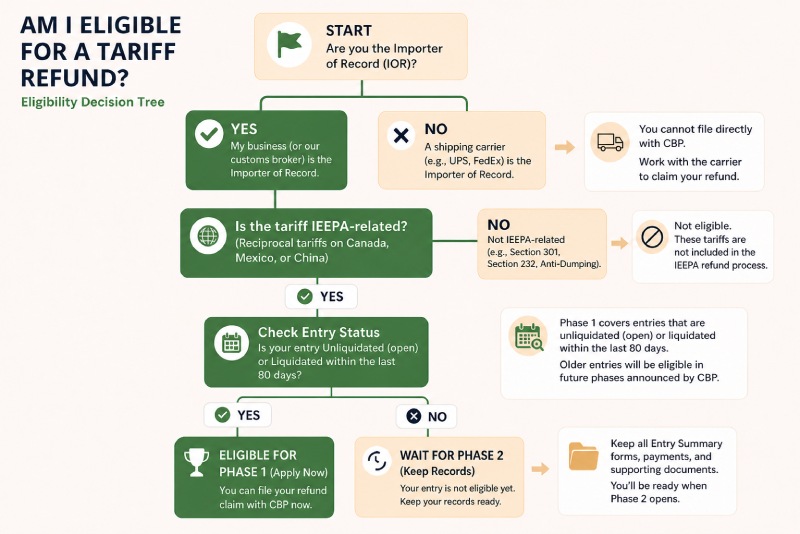
  • Only the Importer of Record (IOR) or an authorized customs broker can claim a refund. If a carrier like UPS or FedEx is the IOR, you must coordinate with them rather than filing directly with the CBP.
     
  • Refunds are exclusively for IEEPA-related tariffs (reciprocal duties on Canada, Mexico, and China). Note that Section 301, Section 232, and Anti-Dumping duties are currently not eligible.
     
  • To file immediately, your entries must be unliquidated (open) or liquidated within the last 80 days. Older shipments are expected to become eligible in future phases announced by the CBP.


The federal government is currently holding upwards of $166 billion in tariff overpayments. As of April 20, 2026, the door to reclaim your share is officially open. 

But these aren’t automatic stimulus checks. Your path to a refund depends entirely on your status as the Importer of Record and the specific nature of your customs paperwork.

Let’s walk through whether or not you qualify and which specific tariff codes are now eligible for an immediate refund.


Who qualifies for a tariff refund?

To qualify for an IEEPA tariff refund, you must be the Importer of Record (IOR) or an authorized customs broker who paid the tariffs directly.

The Importer of Record (IOR) is the individual or entity legally responsible for ensuring imported goods comply with all laws and for paying all duties and tariffs.

Most Suffolk County small businesses act as their own IOR unless they use a third-party shipping service (like FedEx or UPS) to handle the entire import process.

So, how do you determine if you are the IOR?

The easiest way to do this is by reviewing your paperwork:

  1. Look at your Entry Summary form (CBP 7501).
     
  2. If your business name and tax ID are listed as the Importer of Record, you are entitled to claim the refund directly.
     
  3. If a customs broker is listed, they can often apply for the refund on your behalf.

If you used a major shipping carrier like UPS or FedEx, they might be the IOR. In this case, you cannot apply directly to U.S. Customs and Border Protection (CBP).

You must work with the carrier in the tariff refund process. For example, UPS has stated they will apply for refunds for eligible customers and pass the funds through once received.


Which tariffs are eligible for refund?

The tariff refund process specifically applies to IEEPA tariffs. These include the “reciprocal tariffs” and those placed on imports from Canada, China, and Mexico. Not Section 301 (China), Section 232 (Steel/Aluminum), or Anti-Dumping duties.

To see if your shipment qualifies, look at your customs paperwork for a Harmonized Tariff Schedule (HTS) Chapter 99 code. Think of this code as a red flag that indicates an extra emergency duty was tacked onto your standard costs.

Also, refunds are currently being issued in stages. During Phase 1, refunds are strictly limited to two specific categories:

1. Unliquidated entries. These are open shipments where you’ve paid an estimated tariff, but the CBP has not yet finalized the total fees.

This would include a local Long Island boutique owner who just imported a crate of hand-painted ceramics from Mexico last week, for example. 

The shipment has arrived, and the estimated tariff was paid, but U.S. Customs hasn’t closed the book on it yet, making this an unliquidated entry. In a situation like this, you can apply for a refund immediately.

2. Recently liquidated entries. These are shipments finalized (closed) within the last 80 days.

This would apply to a new Suffolk County tech startup that brought in a bulk order of specialized sensors from China three months ago, as another example. They received a final notice from Customs 45 days ago stating the fees were finalized.

The entry is “liquidated,” but it happened within the last 80 days, putting it within the Phase 1 window. 

If your entry was liquidated more than 80 days ago, it is currently ineligible. But the CBP has stated they plan to open refunds for these older shipments soon. Keep your records organized so you’re ready to file the moment the timeline is announced.


Final thoughts 

Let’s take the first step toward getting your money back where it belongs by verifying your refund eligibility. 

Book a call, and we’ll look directly at your Entry Summary forms and HTS codes to confirm whether you’re in the window for an immediate Phase 1 payout.

631-485-7272


FAQs

“How much are the tariff refunds?” 

Following a landmark Supreme Court decision this past February, the government has opened the door for businesses to reclaim upwards of $166 billion in previously paid tariffs. By early April, over 56,000 importers had already secured their spot for electronic refunds, totaling roughly $127 billion. 

“Am I entitled to interest on my tariff refund?” 

Yes. Under federal law, the CBP is required to pay interest on any overpayments, including these IEEPA duties. Interest begins accruing the moment you deposit your estimated duties and continues until the government officially processes your refund. Currently, the interest rate sits at 6%. With the Court of International Trade (CIT) noting that interest is piling up at a rate of roughly $650 million every month, there is a significant financial incentive for you to get your claim filed as soon as possible.

“What if a shipping carrier like UPS or FedEx handled my imports?” 

If you imported goods through a carrier that acted as the Importer of Record (IOR), you cannot file a claim directly with the CBP. Instead, you must coordinate with that carrier. Most major shipping companies have already established internal processes to apply for these refunds on behalf of their clients and pass the payments through once the government releases the funds.

“Is there a deadline for filing a tariff refund claim?” 

For Phase 1, the window is quite tight. Currently, you can only file for shipments that are either still open (unliquidated) or were finalized (liquidated) within the last 80 days. If your shipments are older than that, they are not eligible today, but you should keep your records organized. The CBP plans to open future phases to address the millions of shipments that fall outside this initial window.

The 2026 Business Mileage Rate vs The Standard Expense Method For Your Suffolk County Business Vehicles

The 2026 Business Mileage Rate vs The Standard Expense Method For Your Suffolk County Business Vehicles

Key Takeaways

  • The IRS business rate for 2026 is 72.5 cents per mile, a 2.5-cent increase from the previous year.
     
  • To keep your options open, you must choose the standard mileage method in the first year your vehicle is used for business. If you start with actual expenses, you are locked into that method for the life of the vehicle.
     
  • A contemporaneous log (recorded at the time of your trip) is a non-negotiable IRS requirement. 
     
  • For SUVs and trucks weighing over 6,000 lbs, the actual expense method typically yields a much higher deduction through Section 179 depreciation.
     
  • Regardless of which method you choose, you can always deduct parking fees and tolls separately from your mileage rate.


Driving might be a necessary evil for your business — even more so the logging of mileage for tax write-offs. It’s easy to mess up, though.

Let’s say you do a ‘quick’ 20-mile trip to a client meeting. With the current 2026 business mileage rate sitting at 72.5 cents per mile, that could literally mean a $14.50 deduction. 

But if you don’t log it properly, you’ll miss out on that.

Mileage tracking comes down to choosing the right method for your Suffolk County business… either the standard mileage rate method or the actual expense method.

Here’s everything you need to know to make that call and maximize your vehicle deduction this year.


What is the standard mileage rate method?

The standard mileage rate is a simplified method approved by the IRS that allows small business owners, freelancers, and self-employed individuals to deduct the cost of operating a vehicle for business purposes.

Basically, instead of tracking every individual receipt for gas, oil changes, and repairs, you simply keep a log of your business miles and multiply that total by a fixed rate set annually by the IRS. This rate covers both variable costs (like fuel) and fixed costs (like depreciation and insurance).


What’s the 2026 business mileage rate?

The IRS has set the 2026 business mileage rate at 72.5 cents per mile. Meaning, you can deduct 72.5 cents for every mile you drive for your Long Island business.

So, for example, if you drove 12,000 miles for client meetings and business errands in 2026, your tax deduction would be $8,700.

Many business owners ask me if they can deduct gas on top of the mileage rate. The answer is no. The standard rate is an all-in-one figure designed to cover:

  • Gas, electricity (for EVs), and oil changes
     
  • Maintenance for tires, brakes, and general repairs
     
  • Insurance premium costs associated with the vehicle
     
  • State licensing and registration fees
     
  • The gradual decrease in the vehicle’s value

What you can deduct separately:

  • Parking fees for business-related trips
     
  • Tolls paid while traveling for business
     
  • Interest on a car loan (if you’re self-employed)


How to use the standard mileage rate

To use this method, you must follow specific IRS ground rules so your deduction isn’t disqualified during an audit:

  1. If you want to use the standard mileage rate for a car you own, you must choose to use it in the very first year the car is available for business use. In later years, you can choose to switch between the standard rate and actual expenses.
     
  2. If you lease a vehicle and choose the standard mileage rate, you must use it for the entire lease period, including renewals.
     
  3. You cannot use this method if you operate five or more cars at the same time (i.e., a fleet).
     
  4. Driving from your home to your regular place of business is considered a personal commute and is not deductible. However, driving from your office to a client site or between two different work locations is fully deductible.

The IRS requires a contemporaneous log, meaning you should record your miles at or near the time of your trip. To satisfy an auditor, your log must include:

  • The date of the trip
     
  • The destination
     
  • The business purpose (e.g., “Met with Client ABC for project kickoff”)
     
  • The number of miles driven


What’s the actual expense method for deducting business mileage?

The actual expense method allows you to deduct the specific costs of owning and operating your vehicle for business. Unlike the standard rate, which uses a blanket number, this method tracks the real dollars leaving your bank account.

The core principle of this method is your business use percentage. Since most small business owners use their vehicles for both work and personal life, you can only deduct the portion of expenses that directly relates to your business mileage.

I often recommend this method to my business owner clients who drive heavy vehicles, have high maintenance costs, or have recently purchased a high-value vehicle.


What expenses are deductible with the actual expense method?

Under this method, you can write off a portion of nearly every cost associated with the vehicle, including:

  • Gas, diesel, or charging costs for electric vehicles (EVs)
     
  • Repairs and maintenance for everything from new tires and brake jobs to routine oil changes
     
  • Your annual or monthly commercial or personal auto insurance premiums
     
  • If you lease the vehicle, the business portion of the payments
     
  • Depreciation
     
  • Registration and licenses, including state-specific fees and plate renewals
     
  • Garage rent and tolls for parking or storing the business vehicle


How to calculate the actual expense deduction

Step 1: Calculate business use percentage.
Your business use percentage equals your total business miles divided by your total miles driven in the year, then that total multiplied by 100. 

Step 2: Apply that to your total expenses.
Your total deduction equals the sum of all your vehicle expenses multiplied by your business use percentage.

For example, let’s say in 2026, you spend $10,000 on gas, insurance, and repairs. You drive 20,000 miles total, and 15,000 of those were for business (75% business use). Your deduction would be $7,500 (plus any applicable depreciation).

Keep in mind that while the standard mileage method only requires a mileage log, the actual expense method is much more document-intensive. To survive an IRS inquiry, you must keep:

  • Digital or physical receipts from every gas station visit, repair shop invoice, and insurance payment.
     
  • A mileage log to track your business miles vs. total miles to prove your business use percentage.
     
  • Invoices for the original purchase price or lease agreement of the vehicle.


Standard mileage vs actual expenses for your business vehicle

Deciding between the standard mileage rate and the actual expense method is a decision you should consider carefully. The right choice could save you quite a bit in taxes… but the wrong choice could lock you into a less-than-ideal deduction for years.

Here’s what I tell small business owners to consider when weighing the two options:

1. The weight of your vehicle.

If your business vehicle weighs over 6,000 lbs (common for many full-size SUVs or trucks), the actual expense method is almost always superior. This is because you can claim Section 179 or Bonus Depreciation, allowing you to write off a massive portion of the vehicle’s purchase price in year one.

However, note that the 2026 limit for heavy SUVs (between 6,001 and 14,000 lbs) is capped at $31,300. Non-SUV vehicles over 6,000 lbs (like certain cargo vans) can qualify for the full deduction.

2. Your annual mileage volume.

If you drive a fuel-efficient sedan or a hybrid and put on 20,000+ miles per year, the standard mileage rate is likely your winner. At 72.5 cents per mile, the IRS is essentially giving you a high reimbursement rate that often exceeds your actual cost of gas and maintenance for a small car.

3. Record-keeping capacity.

The actual expense method requires you to save every single receipt for gas, car washes, oil changes, and insurance for at least three years. If you aren’t organized, you risk losing your deduction during an audit. The standard mileage rate only requires a single mileage log.

4. Vehicle purchase price.

If you bought an expensive luxury vehicle for business, the depreciation deduction under the actual expense method will likely be far higher than what the standard mileage rate provides. Conversely, if you drive a used vehicle with a low book value, the mileage rate is usually more profitable.


Can you switch between mileage and actual expense methods?

Choosing between the standard mileage rate and actual expenses is about committing to a method for the long-term.

The reality is that the IRS gives you a one-time window to keep your options open. To use the standard mileage rate at any point, you have to select it in the very first year the vehicle is available for business use. If you lead with actual expenses in Year 1, you’re permanently locked into that method until you sell or trade the vehicle.

Starting with the mileage rate gives you the flexibility to toggle over to actual expenses in later years if your maintenance costs spike or your mileage drops.

So, if you’re unsure which method to pick, start with the standard mileage rate in Year 1.

If you do that, you can switch to actual expenses in year 2, 3, or later if your repairs go up or your mileage goes down.

But if you choose actual expenses in year 1, you’re locked in. You must use the actual expense method for the entire life of that vehicle until you sell it or trade it in.


How to track business mileage 

Regardless of the method you choose, the IRS requires specific data points to substantiate your deduction. If your log is missing any of these, the entire deduction could be disqualified.

  • Date of the trip
     
  • Total miles driven for each business trip
     
  • Destination (city, state, or specific address)
     
  • Business purpose (e.g., “Client sales presentation” or “Supply run to Office Depot”).
     
  • Yearly odometer readings recorded at the start (Jan 1) and end (Dec 31) of the year to establish your total vs. business mileage

Modern apps use GPS and motion sensors to detect when you start driving. So you don’t have to worry about forgetting to write down a trip after a long day of meetings.

Apps also automatically capture the exact start/end addresses and timestamps, creating a digital breadcrumb trail that’s much harder for an auditor to dispute than a handwritten notebook.

Top-tier apps can even AI to recognize your frequent routes (like your weekly trip to the post office or a recurring client site) and auto-classify them as “Business,” saving you hours of administrative work.

A few mileage tracking apps I recommend looking into:

  • MileIQ: Best “swipe-to-classify” interface.
     
  • Everlance: Syncs with your bank account to track receipts and mileage.
     
  • TripLog: Great if you have multiple vehicles or employees.
     
  • Everlance: Tracks both mileage and receipts in one dashboard.
     
  • MileageWise: Features AI that can reconstruct lost logs from your calendar.


Final thoughts 

As your tax pro, I specialize in “toggling” the math in these situations. Before you choose, I can run your data through both scenarios to see exactly which one yields the highest deduction for your specific vehicle and driving habits. 

Schedule a strategy session, and let’s find your maximum write-off together:

631-485-7272


FAQs

“Can I deduct gas and repairs on top of the 72.5-cent mileage rate?”

No. If you choose the standard mileage rate, you cannot separately deduct gas, oil changes, tires, or repairs. The 72.5-cent rate is an all-inclusive figure designed by the IRS to cover both variable costs (fuel and maintenance) and fixed costs (insurance and depreciation). However, you can still deduct parking and tolls separately.

“Do electric vehicles (EVs) qualify for the standard mileage rate in 2026?”

Yes. The 2026 business mileage rate of 72.5 cents per mile applies equally to gasoline, diesel, electric, and hybrid vehicles. For EV owners, the standard rate often provides a significantly higher deduction than the actual expense method because the cost of electricity per mile is typically much lower than the built-in fuel cost the IRS rate assumes.

“Can I switch from the actual expense method to the standard mileage rate later?”

Generally, no. If you choose the actual expense method in the first year you use a vehicle for business, you are locked in and must use that method for the entire life of the vehicle. However, if you choose the standard mileage rate in year 1, you have the flexibility to switch to actual expenses in any subsequent year.

“Is my daily commute from home to my office tax deductible?”

No. The IRS considers commuting from your residence to your regular place of business a personal expense, regardless of how far you drive or what work you do during the commute. Only trips from one work location to another, or from your office to a client site or supply store, are deductible as business miles.

“Can I use the standard mileage rate if I operate a fleet of vehicles?”

You cannot use the standard mileage rate if you operate five or more cars at the same time for your Suffolk County business. The IRS considers this a fleet operation and requires you to use the actual expense method to track costs for those vehicles.

“What documentation is required for tracking business mileage?”

To satisfy the IRS, you must keep a contemporaneous mileage log. This record should include the date of each trip, the business purpose, the destination, and the number of miles driven. Using a GPS-based tracking app is the most reliable way to maintain these records and prove your business use percentage to an auditor.

“Can I deduct the interest on my car loan?”

If you’re self-employed, you can deduct the portion of your car loan interest that relates to the business use of your vehicle. This deduction is available regardless of whether you choose the standard mileage rate or the actual expense method.